

目次
Ideal Conditions Rarely Exist on the Shop Floor
Sanding work in Costa Rican woodworking shops rarely takes place under ideal conditions. Instead, it happens amid unstable working postures, inconsistent pressure, and limited tooling.
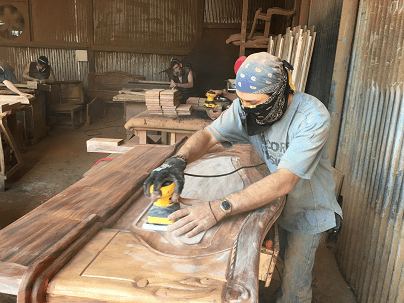
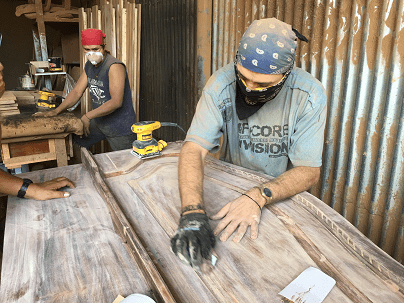
Sanding Work at Woodworking Sites in Costa Rica Quality is shaped by manual technique and tool handling
Every shop carries its own variability—differences between workers, differences in tool condition, differences between individual workpieces. Evaluations built around ideal conditions simply don't hold up as-is in this environment.
Four Factors That Shape Quality
What matters on the shop floor isn't which tool is used, but how it's used. Even with the same product, the outcome can vary widely depending on technique—a premise shared across every shop we observed.
Quality is ultimately determined by how these four factors come together. Conversely, if even one of them breaks down, the finish suffers.
The Sanding Equipment Actually in Use
Shops rely on a variety of belt sanders, but most are secondhand machines with no standardized specifications or belt sizes. This, too, is part of the "conditions will never be uniform" reality these shops operate in.
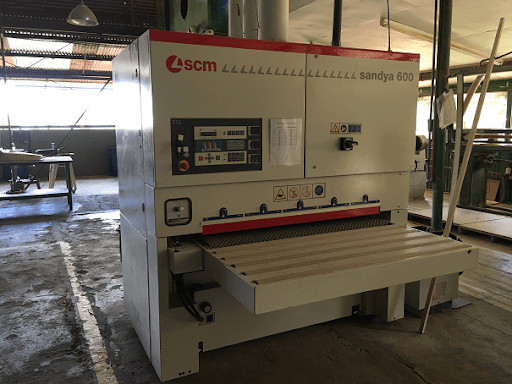
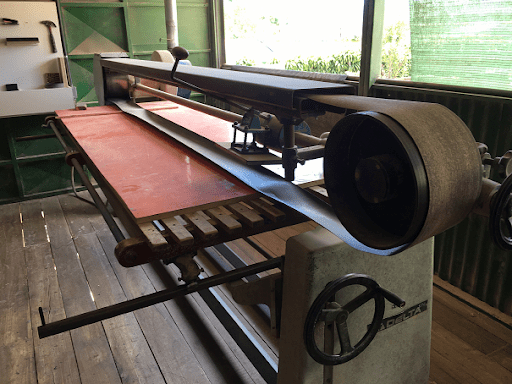
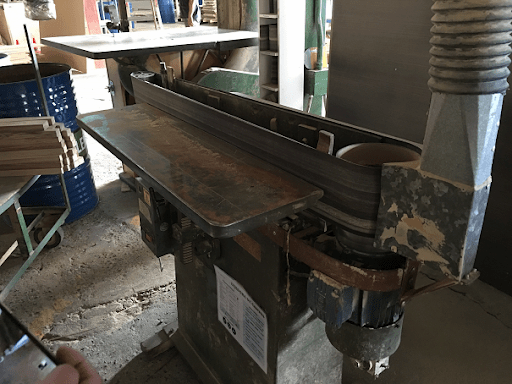
Various Belt Sanders Used On-Site Many are used/secondhand machines, with no standardized specifications or belt sizes
In an environment like this, process design built around equipment standardization simply doesn't work. What's required instead is understanding the quirks of each individual machine and adapting technique accordingly.
The Challenge of Reproducibility
In this kind of environment, what matters more than a one-off good result is reproducibility. Getting it right once means little if the next worker, the next workpiece, or the next day can't deliver the same outcome.
Stable behavior
Results that don't shift much even as technique varies
Ease of handling
The ability to produce consistent results regardless of skill level
Low variability
Minimizing quality differences between individual workers
The starting point for any proposal suited to real-world shop conditions is this: how do you reliably reproduce a stable result within the environment you're actually given?
Conclusion
On-site sanding quality is determined not just by product performance, but by how tools are used and the conditions under which they're used. Simply switching tools won't raise quality—what matters is optimizing the four core factors—application, angle, pressure, and time—to fit the realities of each individual shop.
No,514