

Introduction

Walking through woodworking markets in Central America, you sometimes come across a curious sight. Amid shelves lined with the latest high-performance abrasives, traditional hide glue (nikawa) cloth abrasives still hold a notable presence.
What's more, they aren't simply treated as low-cost alternatives. A technical representative from a paint manufacturer noted, "This softness can't be fully replicated with resin," while local woodworkers describe how "the feel the moment it touches the wood is different" and that "it's harder to over-sand." Here lies a value that a simple spec comparison cannot explain.
— Technical representative, local paint manufacturer
The reality of shelf life
One reason hide glue products survive is "real-world shelf life in the actual market." Under ideal factory conditions, high-performance resin products deliver excellent performance. In practice, however, real-world global distribution conditions are far less straightforward.
As a result, in some cases the performance the product was originally designed for changes before it ever reaches the user. Hide glue products, on the other hand, can retain their usability for a very long time when stored under appropriate conditions.
A case from a long-established Nara manufacturer
At a long-established abrasive cloth and paper manufacturer in Nara, hide glue products made at the time of the company's founding are still kept in storage today. This doesn't mean the material "never deteriorates," but it does show that in certain market environments, the properties of hide glue function as a real, practical advantage.
Softness and conformability
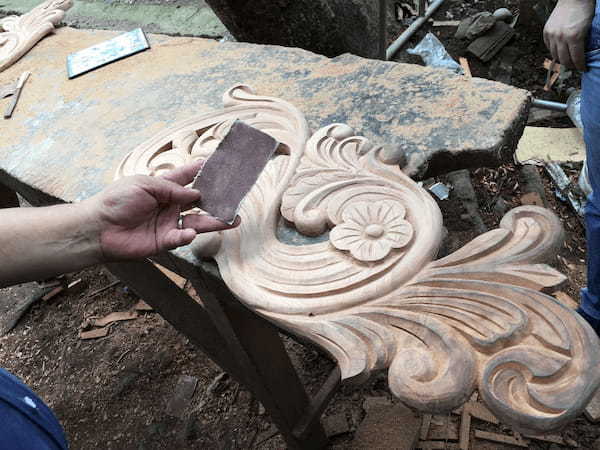
Even for complex curved-surface work, hand-use cloth abrasives are still used today in woodworking workshops across Central America.
Another reason is "conformability." Resin is highly durable but relatively hard. Hide glue bonding, by contrast, is softer and has more organic properties.
Compatibility with hand work Wood is constantly changing with temperature and humidity. There are situations that call for a material with a degree of "give," rather than one that is completely rigid. This sense of tactile control is especially valued in woodworking markets centered on hand work.
Value beyond the spec sheet
From a purely industrial-rationality standpoint, the shift to resin was a natural progression. Indeed, in many applications, resin products deliver overwhelmingly superior performance.
But the market doesn't always choose "the highest-performing technology" alone. In actual work settings, multiple factors overlap — distribution conditions, storage conditions, material properties, and the worker's own feel. As a result, a technology that may look outdated can still remain a rational choice today.
Perhaps what makes the world of abrasives so interesting is that value which cannot be explained by a simple spec race still exists today.
No,524